
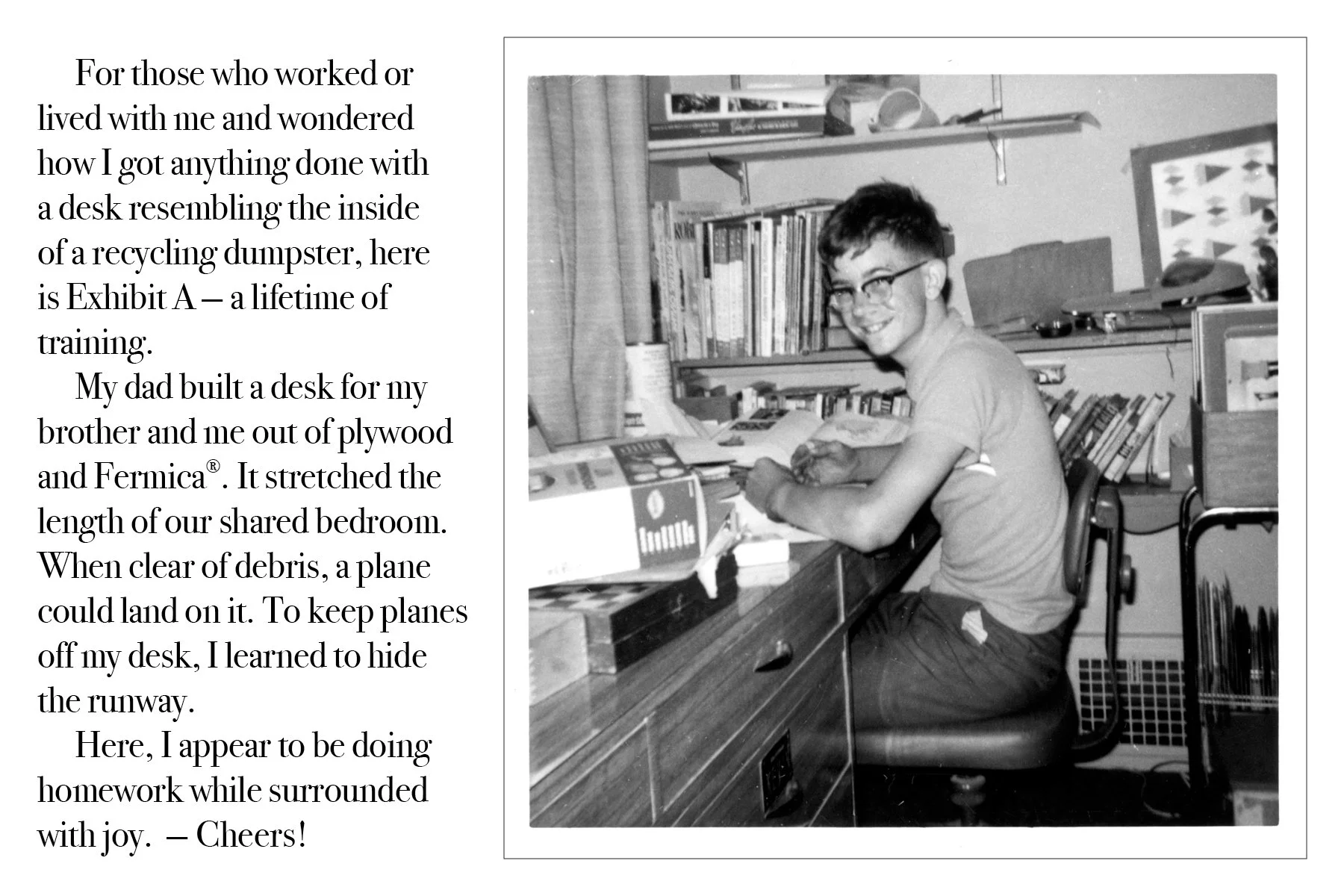
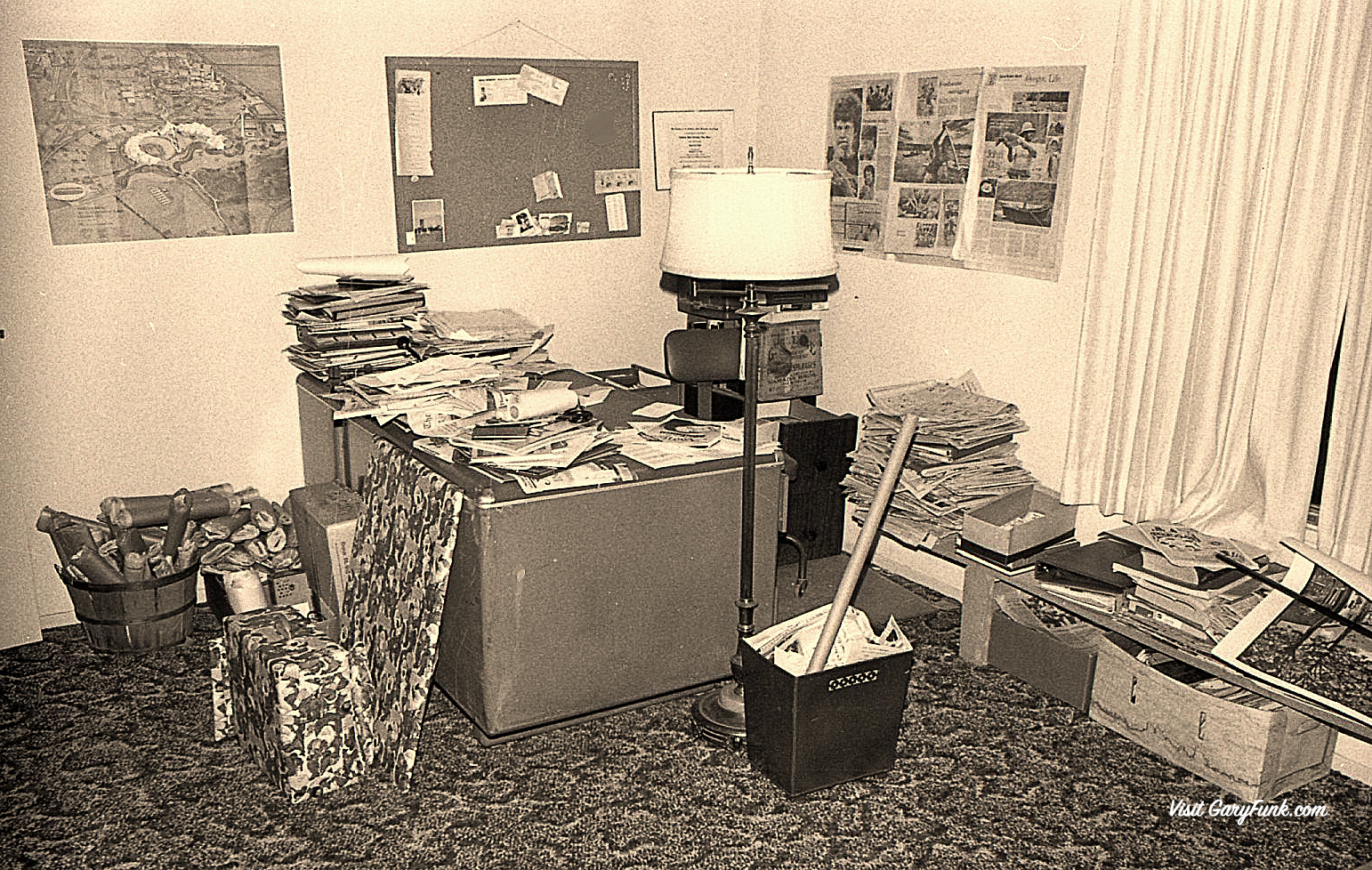
I wore glasses since the 3rd grade. Maybe that’s why I like to keep things close to me. It’s not clutter!
Family History

I took this picture in 1972 outside the Segundo Dining Commons at UC Davis. Years later, I visited, and the building had been torn down and replaced. I made this card as a nod to progress. I guess I liked the intersecting lines and the shape of the bicycle that interrupts them.
Ode to a postcard
in Family History, humor, holiday
I like the concept of postcards. Except for needing a stamp, they are the original form of Twitter, Instagram, or TikTok, offering the reader (usually someone you knew) a glimpse into your life.
“Hi, Grandpa! We’re visiting Disneyland! It’s really fun! Kevin threw up on the tea cups! Hope you are fine. — Love, Gary.”
For a 10-year-old with unattractive handwriting, that’s all I could say in the space allotted. The photo on the front would be of the Santa Fe and Disneyland Depot, Mickey Mouse, or some other exotic-land attraction not found in Ohio, where Grandpa lived. My mother scribbled the date at the top of the card before dropping it into a mailbox.
Sometimes, Grandpa would write back in the form of a letter, often months later. “Glad you had fun at Disneyland. Is your brother better? How ‘bout the Indians? The Dodgers look tough this year? Say ‘Hi’ to everyone. — Love, Grandpa.”
If you were fortunate, your parents kept these missives between family members, even if it was only to prove to themselves that their kids could string a sentence or two together. Postcards became part of the family history. I’m sorry to say this exchange was not one of them.
So, what happened to postcards? “It’s the price of stamps,” I heard someone say. “Good excuse,” I heard myself think. The cost of a postcard stamp is now 56 cents. In my old-man inner voice, I ask, “How much do you pay monthly for an internet service provider? Or the data on your phone?” And if you have both? It’s not 56 cents.
But I suppose it would add up if you bought a stamp every time you wanted to “chat” with a buddy:
“Wasup?”
“Nothin”
“LOL”
“WTF”
That’s $2.24 right there. And that’s not taking into account the cost of a postcard.
Then I think about what communication guru Marshall McLuhan said, “The medium is the message.”
Instant feedback requires instant feedback, hence the abbreviation and accompanying memes. And all that is worth $100s a month. Right?
But putting pencil or pen to paper requires some thought and is often inspired by an event, such as a memorable trip, a birthday, or a holiday. It was rarely inspired by breakfast.
Sometimes, it was inspired by my mother asking, “Did you write your Tante Wali to thank her for the PJs she sent you for Christmas?”
I’d grab a postcard from my desk drawer, possibly a deer in Yosemite, and write: “Liebe Tante Wali, vielen Dank für den Schlafanzug. Das Stacheldrahtmuster war in den Wohnheimen ein Hit.“ Translation: “Dear Tante Wali, Thank you for the PJs. The barbed wire pattern was a hit in the dorm.”
Over the years, I have found myself collecting random postcards and greeting cards, which sometimes irritates my family. But if you get one from me, it means something crossed my path or my mind that made me think about you.
In the meantime, I will occasionally use this forum to post postcards of my own creation. You can take it or leave it. They’ll be hybrids—postcards as memes? If you’d like to share one with your friends or family, let me know.
LOL
— Cheers!

The original paper from my father’s files. Note: Andy Rooney wrote the “Good” column at the bottom of the page.
May 7, 1945: World War II ends
Note: My father wrote a memoir about his tour of duty in the U.S. Army during World War II. He was on leave in Nice, France, when Germany announced its surrender.
The War Ends in Europe
By Richard S. Funk
The news from the German front in Stars & Stripes indicated that the end of the war was at hand. As luck would have it, the Cease Fire Agreement ending hostilities was signed at General Eisenhower’s headquarters in Reims, France, on May 7 — the day before I was supposed to fly back to rejoin Battery B and the 14th Armored.
Fortunately, the flight on the 8th was canceled since everyone was celebrating and the pilots probably had too much to drink.
The next day, the plane was to depart at 1 p.m., which it did. The problem was that it did not get very far. After take-off, we noticed that the pilot was doing a lot of circling to the left, and finally, we were skimming alongside the ominous hills at the airport and came in for a landing back where we had started. The co-pilot jumped out and removed an aileron chock that restrained the right wing flap from moving. Someone had forgotten to pull it off before our take-off, and without the flap, the pilot was only able to fly in circles to the left.
The second time was a charm.
However, most of the plane was loaded with Army nurses, and I guess the pilots wanted to impress them. Anyway, instead of flying at a more normal altitude, he flew low — just a few hundred feet above the treetops. This gives the impression of greater speed. It also scared the hell out of farmers and livestock on the French and German farms we flew over on the way back to Nuremberg.
All the passengers on board had their fingers crossed, thinking what a shame it would be if we had survived the war but were killed in a plane crash the day after the armistice. But we arrived safely.
I finally located Captain Kelly and the Battery B half-tracks near the airport at Landshut, Germany, where they were helping to process liberated American, English, and French prisoners of war for flights back to their homelands.
Naturally, my buddies wanted to know what kind of close relationship I had with General Patton that enabled me to be vacationing on the Riviera when the war ended. I had no answer to that question.
But I did have some answers to other questions.
How long had we been on combat alert since landing in France? Answer: 281 days.
How many miles did we cover?
Answer: 3,350 miles-at least that was the mileage on the odometer of Captain Kelly’s jeep.
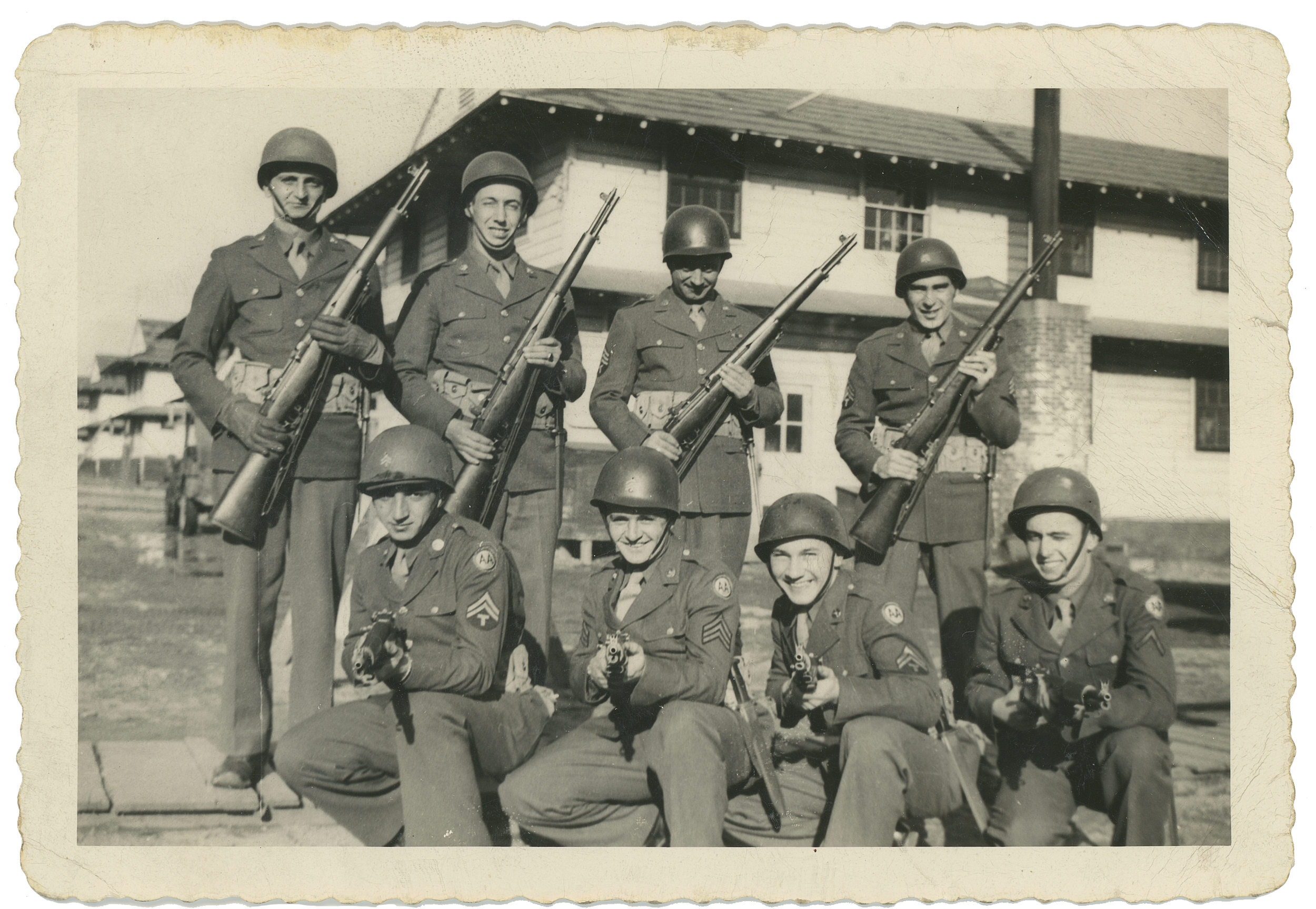
Comrades in arms, getting ready for war. .This is what my father wrote for a caption, “Communications Section — 398th AAA AW Bn (SP): Bottom Row, L to R: Todesco, Euart, Funk, Tighe; Top Row, L to R: Gaudette, Ross, beck, Fingerhut.”